
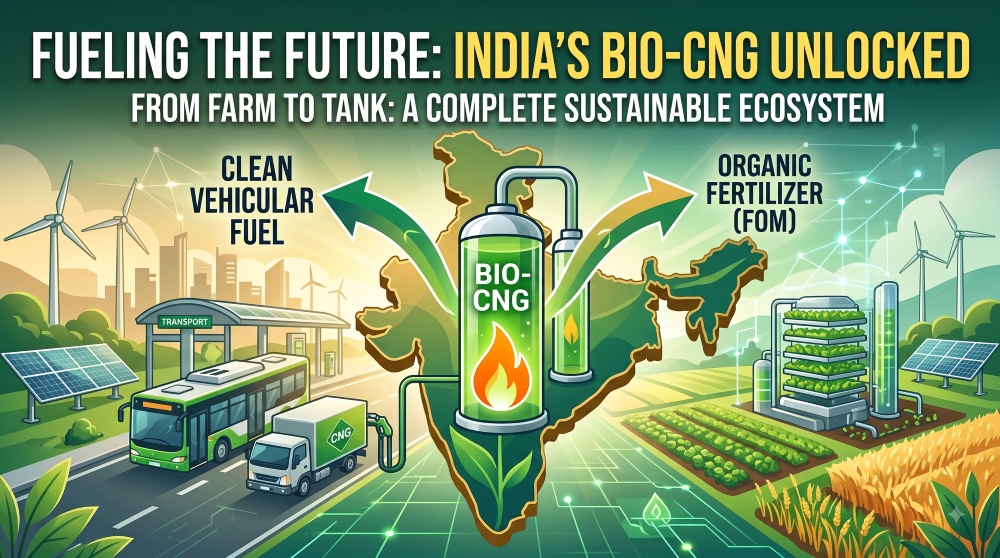
India stands at a unique crossroads in its clean energy transition. As one of the world’s fastest-growing economies, the nation faces a dual challenge: meeting a rapidly expanding appetite for energy while curbing severe urban air pollution and cutting reliance on expensive fossil fuel imports.
Enter Compressed Bio-Gas (CBG), commonly known as Bio-CNG. Harnessing India’s vast agricultural biomass, livestock waste, and municipal solid waste, Bio-CNG is rapidly moving from an alternative energy concept to a central pillar of India’s green economy.
Why India Needs Bio-CNG Right Now
The economic and environmental drivers behind India’s push into Bio-CNG are compelling:
- Heavy Fossil Fuel Dependency: India currently imports over 85% of its crude oil and around 50% of its natural gas. Scaling up domestic Bio-CNG directly improves energy independence and protects the economy from global price shocks.
- The Stubble Burning Crisis: Every autumn, agricultural stubble burning across northern states like Punjab and Haryana leads to severe air pollution in the National Capital Region (NCR). Bio-CNG offers a lucrative alternative: turning field residue into high-value fuel.
- Abundant Feedstock Supply: India generates over 700 million tonnes of agricultural residue annually, alongside massive quantities of cattle dung (gobardhan), sugarcane press mud, and urban organic waste.
The Policy Engine: Key Government Initiatives
The Indian government has established a robust policy framework to accelerate Bio-CNG production across the country.
1. The SATAT Initiative
Launched by the Ministry of Petroleum & Natural Gas, the SATAT (Sustainable Alternative Towards Affordable Transportation) scheme aims to establish thousands of commercial CBG plants across India. Under SATAT, Oil Marketing Companies (OMCs) like IOCL, BPCL, and HPCL offer long-term guaranteed off-take agreements to buy CBG from developers at standardized rates.
2. Mandatory Blending Obligations (CBO)
To guarantee off-take, the government introduced phased Compressed Biogas Obligations (CBO) for City Gas Distribution (CGD) entities. Beginning with mandatory $1\%$ blending in CNG for transport and PNG for domestic use, this target gradually increases, creating an assured market demand for producers.
3. Financial Incentives & Viability Gap Funding (VGF)
The Ministry of New & Renewable Energy (MNRE) provides central financial assistance and Viability Gap Funding (VGF) to reduce upfront capital expenditure for new plant setups. Additionally, priority sector lending (PSL) status from banks makes debt financing far more accessible for developers.
4. GOBARdhan Scheme
The Galvanizing Organic Bio-Agro Resources Dhan (GOBARdhan) initiative focuses on managing livestock waste and organic farm refuse in rural areas, turning waste into wealth while supporting decentralized Bio-CNG production.
Economic Potential: Closing the Circular Economy Loop
Bio-CNG is not just a fuel; it is a multi-stream revenue generator that transforms rural economic dynamics.
+-------------------+      +-----------------------+      +--------------------------+
|  Agri Residue &   | ---> |   Anaerobic Digestion | ---> |  Bio-CNG (Transport)     |
|   Organic Waste   |      |     & Refining        |      |                          |
+-------------------+      +-----------------------+      |  Fermented Organic       |
                                                          |  Manure (Soil Health)    |
                                                          |                          |
                                                          |  Carbon Credits (CCTS)   |
                                                          +--------------------------+
Primary Revenue Streams for Bio-CNG Plants:
- Bio-CNG Sales: Guaranteed off-take by OMCs for vehicular fuel and industrial supply networks.
- Fermented Organic Manure (FOM): High-grade organic fertilizer produced as a byproduct, helping enrich depleted Indian soils and reducing reliance on chemical subsidies.
- Carbon Credits: Participation in India’s Carbon Credit Trading Scheme (CCTS) adds a high-margin supplementary revenue stream.
Key Challenges to Overcome
Despite strong tailwinds, the sector faces several operational hurdles that require targeted solutions:
- Feedstock Supply Chain Management: Because crop residue generation is seasonal, developers must set up robust collection, baling, and storage networks to guarantee a year-round feedstock supply.
- Capital Cost & Financing Realities: High initial capital expenditure for advanced anaerobic digestion, gas purification (membrane or PSA technology), and compression equipment still requires strong financial backing.
- Off-take Infrastructure: Expanding pipeline connectivity and cylinder cascade logistics is critical to transport gas efficiently from rural production hubs to urban consumption centers.
The Road Ahead: India’s Clean Energy Horizon
India’s Bio-CNG landscape is undergoing a major structural transformation. With active participation from major energy conglomerates, private entrepreneurs, and agricultural cooperatives, the sector is shifting from small-scale pilot projects to industrial-scale energy production.
By bridging the gap between agriculture and energy, Bio-CNG addresses air pollution, strengthens rural livelihoods, improves soil health, and moves India closer to its Net-Zero carbon targets.