
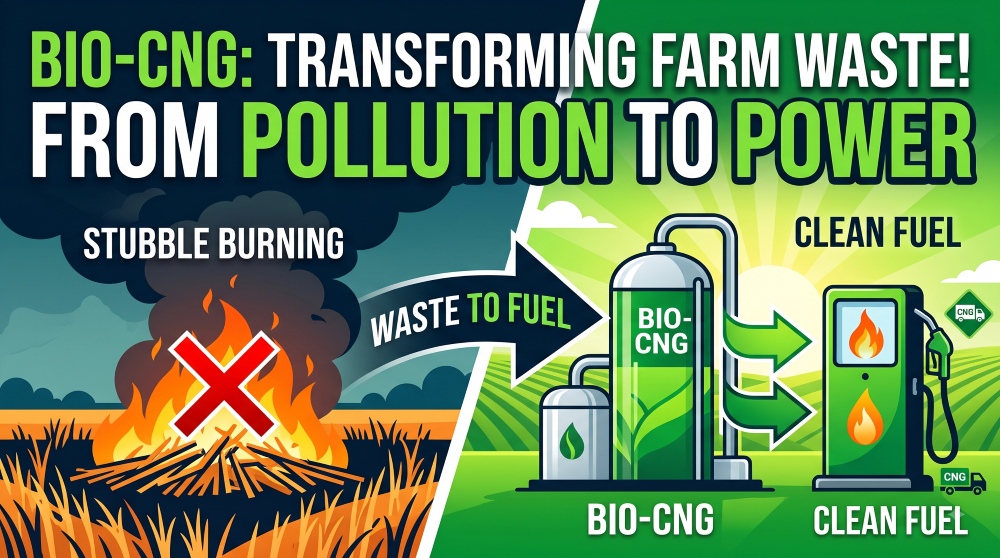
Every harvesting season, vast stretches of farmland present a recurring dilemma: millions of tons of agricultural residues such as paddy straw, sugarcane bagasse, and crop stubble are left behind. Historically, the fastest way to clear fields for the next planting cycle has been stubble burning. This practice releases severe air pollution, degrades soil biology, and wastes valuable organic material.
Enter Bio-CNG (Compressed Biogas).By taking agricultural waste and converting it into a purified, high-energy fuel, Bio-CNG is reshaping rural economies, reducing carbon footprints, and offering a sustainable alternative to fossil fuels.
What Is Bio-CNG?
Bio-CNG is a purified form of biogas derived from the decomposition of organic matter. Raw biogas produced from farm waste typically contains around $55\text{–}65\%$ methane ($\text{CH}_4$), with the remainder mostly consisting of carbon dioxide ($\text{CO}_2$) and trace gases like hydrogen sulfide ($\text{H}_2\text{S}$).
To make Bio-CNG, raw biogas undergoes a cleaning and upgrading process to remove $\text{CO}_2$, moisture, and impurities.The end result is a fuel with a methane concentration exceeding $90\%$, making its chemical composition and calorific value virtually identical to commercial Compressed Natural Gas (CNG).
From Stubble to Fuel: The Transformation Process
The process of converting agricultural residue into vehicular-grade fuel combines biological engineering with advanced gas purification.
1. Biomass Collection and Pre-treatment
Crop residue, crop stalks, and animal manure are collected from farms. Because agricultural waste contains tough, fibrous materials like lignin and cellulose, it undergoes mechanical shredding and chemical or enzymatic pre-treatment to break down these complex structures for easier microbial digestion.
2. Anaerobic Digestion
The prepared biomass is fed into sealed, oxygen-free tanks called anaerobic digesters. Inside, specialized consortia of bacteria break down the organic matter across four primary biological stages:
- Hydrolysis: Complex polymers are broken down into simple sugars and amino acids.
- Acidogenesis: Soluble compounds are converted into volatile fatty acids (VFAs).
- Acetogenesis: VFAs are converted into acetic acid, hydrogen, and carbon dioxide.
- Methanogenesis: Methanogenic archaea consume these products to generate methane gas ($\text{CH}_4$) and $\text{CO}_2$.
3. Gas Purification & Upgrading
The raw biogas is routed through scrubbing systems, membrane separation units, or Pressure Swing Adsorption (PSA) systems.These technologies strip away hydrogen sulfide, moisture, and carbon dioxide to yield biomethane with high purity ($>90\%\ \text{CH}_4$).
4. Compression and Distribution
Finally, the biomethane is compressed to approximately $200\text{–}250\text{ bar}$. It is then stored in cascades or piped directly into transport vehicles, industrial burners, or grid pipelines.
The Dual Advantage: Bio-CNG vs. Fossil CNG
| Feature | Fossil CNG | Bio-CNG |
| Source | Geological extraction (finite) | Agricultural waste & biomass (renewable) |
| Carbon Footprint | Net-positive carbon emissions | Near net-zero carbon lifecycle |
| Environmental Impact | Depletes non-renewable reserves | Mitigates farm emissions & stubble burning |
| By-products | None | Nutrient-rich organic fertilizer (Fermented Organic Manure) |
Key Benefits of the Bio-CNG Revolution
1. Eliminating Agricultural Air Pollution
By creating a commercial market for agricultural waste, farmers are incentivized to collect and sell stubble rather than burning it.This directly reduces seasonal smog, particulate matter ($\text{PM}_{2.5}$ and $\text{PM}_{10}$), and greenhouse gas emissions.
2. Boosting the Rural Economy
Bio-CNG plants establish a circular economy in agricultural regions:
- New Income Streams: Farmers can sell crop residues that were previously considered trash.
- Job Creation: Biomass supply chains—from collection and baling to transport and plant operation—create steady rural employment.
3. Closing the Nutrient Loop
A critical byproduct of anaerobic digestion is Fermented Organic Manure (FOM). Rich in nitrogen, phosphorus, potassium, and organic carbon, this byproduct can be returned to fields as an organic fertilizer. Replacing chemical fertilizers with FOM restores soil structure, improves water retention, and rebuilds beneficial microbial populations destroyed by stubble burning.
4. Enhancing Energy Security
For countries heavily reliant on imported crude oil and natural gas, scaling up domestic Bio-CNG production reduces import dependency, buffers against global energy price volatility, and strengthens national energy resilience.
Overcoming Key Operational Challenges
While the benefits are clear, widespread adoption requires addressing a few operational hurdles:
- Logistics and Biomass Supply Chains: Agricultural waste is bulky and seasonally generated. Establishing efficient collection, baling, storage, and transport networks is vital to ensure Bio-CNG plants have a consistent feedstock year-round.
- Capital Intensity: Setting up high-capacity anaerobic digestion and modern membrane-upgrading infrastructure requires significant upfront capital investment.
- Grid and Retail Integration: Expanding off-take infrastructure—such as integrating Bio-CNG into existing city gas distribution networks—remains essential for long-term scalability.
The Road Ahead
Bio-CNG represents a practical shift in how we view agricultural waste. By treating farm residues as energy-rich feedstocks rather than disposal problems, Bio-CNG facilities address air quality, soil degradation, energy security, and rural income in a single, closed-loop system. As processing technologies advance and supply chain logistics mature, converting waste into clean fuel will play a central role in the global transition toward sustainable energy.