
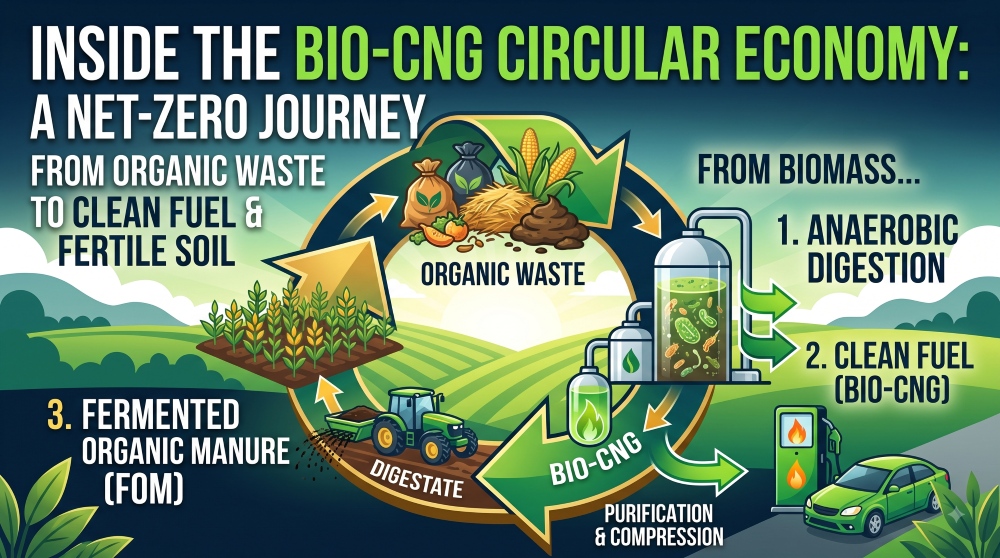
For decades, linear economic models—the traditional “take, make, and dispose” mindset—have dominated global waste management and energy production. Organic waste, whether from municipal food scraps, livestock manure, or post-harvest crop residues, was treated as a liability to be buried in landfills, dumped into waterways, or burned in open fields.
The rise of Bio-CNG (Compressed Biogas) flips this paradigm on its head. By integrating modern anaerobic digestion and gas upgrading technologies, Bio-CNG transforms biological waste management into a closed-loop circular economy.
What Is a Circular Economy in Energy?
In a traditional linear energy system, fossil fuels are extracted from the earth, refined, combusted, and permanently lost to carbon emissions.
A circular energy economy, by contrast, operates on three fundamental principles:
- Eliminating waste and pollution by design.
- Circulating products and materials at their highest value for as long as possible.
- Regenerating natural systems like topsoil and agricultural ecosystems.
Bio-CNG achieves all three by turning discarded organic materials into a self-sustaining cycle of energy production and agricultural restoration.
The Circular Bio-CNG Loop: Step-by-Step
        +--------------------------------------------------+
        |                                                  |
        v                                                  |
 [Organic Waste Streams]                                   |
(Agri Residues, Food Waste, Manure)                        |
        |                                                  |
        v                                                  |
[Anaerobic Digestion]                                      |
        |                                                  |
        +-------------------------+                        |
        |                         |                        |
        v                         v                        |
  [Raw Biogas]             [Digestate Organic Matter]      |
        |                         |                        |
        v                         v                        |
 [Gas Upgrading]           [Fermented Organic Manure]      |
        |                         |                        |
        v                         v                        |
   [Bio-CNG]               [Soil Enrichment & Crops] ------+
(Clean Mobility Fuel)        (Regenerates Farmland)
1. Organic Feedstock Aggregation
The loop begins with collecting diverse waste streams that would otherwise decompose uncontrolled and release methane into the atmosphere:
- Agricultural Waste: Paddy straw, corn stalks, sugarcane bagasse, and press mud.
- Animal Husbandry: Cow dung, poultry litter, and dairy farm slurry.
- Urban & Industrial: Municipal solid waste (MSW) organic fractions, food processing wastewater, and commercial kitchen scraps.
2. Biological Conversion via Anaerobic Digestion
Inside sealed digester tanks, naturally occurring bacteria break down the organic biomass in an oxygen-free environment. This biological process prevents raw methane from venting into the atmosphere while breaking complex organic compounds into simple nutrients and raw biogas.
3. Upgrading to Vehicular-Grade Fuel
Raw biogas is scrubbed of carbon dioxide ($\text{CO}_2$), hydrogen sulfide ($\text{H}_2\text{S}$), and moisture. The resulting high-purity biomethane ($>90\%\ \text{CH}_4$) is compressed into Bio-CNG. It serves as a direct, drop-in replacement for fossil natural gas in heavy transport, commercial fleets, and industrial heating.
4. Returning Nutrients to the Soil: Fermented Organic Manure (FOM)
Unlike fossil fuel combustion, which leaves behind only emissions and toxic byproducts, the anaerobic digestion process yields a nutrient-dense byproduct called Fermented Organic Manure (FOM) or digestate.
FOM is rich in nitrogen, phosphorus, potassium, and organic carbon. When reapplied to farmland:
- It replaces synthetic chemical fertilizers.
- It improves soil water retention and microbial health.
- It supports healthy crop growth, yielding the next cycle’s biomass.
Multi-Value Creation in the Bio-CNG Cycle
| Value Stream | Linear Model Impact | Bio-CNG Circular Model Impact |
| Waste Management | Landfill dumping & open field burning | Zero-waste valorization of organic streams |
| Atmospheric Carbon | Uncontrolled greenhouse gas emissions | Net-zero carbon combustion loop |
| Soil Health | Chemical degradation & erosion | Regeneration via organic carbon manure |
| Economic Value | High disposal costs & fuel imports | Domestic energy generation & nutrient recovery |
Environmental and Carbon Accounting
The most remarkable aspect of the Bio-CNG circular economy is its net-zero—and often carbon-negative—lifecycle impact.
- Avoided Methane Emissions: Organic waste left in landfills or manure pits decomposes anaerobically on its own, releasing raw methane ($\text{CH}_4$) into the atmosphere. Because methane is over 28 times more potent as a greenhouse gas than carbon dioxide over a 100-year timescale, capturing it inside a sealed digester eliminates massive fugitive emissions.
- Fossil Fuel Displacement: Replacing conventional natural gas or diesel with Bio-CNG directly reduces carbon intensity in transport and manufacturing.
- Soil Carbon Sequestration: Returning organic carbon to the soil through Fermented Organic Manure traps carbon in the ground, reversing land degradation.
Building the Infrastructure for Scale
To make the Bio-CNG circular economy ubiquitous, key operational enablers are essential:
- Efficient Supply Chains: Setting up localized hubs for collecting, sorting, and pre-treating organic waste streams ensures continuous bioreactor operation.
- Co-Digestion Innovations: Mixing multiple feedstocks—such as food waste with dairy slurry—optimizes methane yield and ensures plant stability throughout varying harvest seasons.
- Market Integration: Standardizing quality metrics for Fermented Organic Manure (FOM) alongside gas grid injection standards accelerates commercial uptake across farming and industrial sectors.
The Ultimate Closed Loop
The Bio-CNG circular economy demonstrates that environmental sustainability and economic viability can exist together seamlessly. By viewing organic waste not as trash, but as a critical feedstock for energy and agriculture, we can phase out finite fossil resources, protect atmospheric air quality, and restore the biological health of our lands for generations to come.